Metal Reflective Coatings (Part 2) | Aluminum (Al) Reflective Coatings
Aluminum reflective coatings are one of the most widely used and cost-effective general-purpose reflective coatings. Automotive headlamp reflectors, cold mirrors, UV optical lenses, and standard instrument mirrors all rely heavily on aluminum coatings.
I. Optical and Material Fundamentals of Aluminum Coatings
Optical Advantages
Aluminum is a mass-production reflective metal with high reflectance across the full spectrum from UV → visible → infrared:
- UV: approximately 91.8% reflectance at 220 nm
- Visible: approximately 91.6% reflectance at 550 nm
- Infrared: approximately 98% reflectance at 10 μm
Reflectance only shows a slight drop to around 86% near 850 nm. There are no obvious absorption valleys across the full spectrum, and polarization changes under oblique incidence are minimal.
Material Characteristics
High-purity aluminum coatings spontaneously form a dense Al₂O₃ passivation layer when exposed to air, providing oxidation resistance significantly better than silver.
Mass-production standards for source materials:
- Coating-grade aluminum ingots / aluminum wire purity: ≥99.99%
Excessive impurities may cause:
- Coating darkening
- Reduced reflectance
Applications
- General optical mirrors
- Automotive headlamp reflectors
- Cold mirrors
- UV inspection windows
- Low-cost infrared reflective components
II. Key Process Parameters for Mass Production Vacuum Deposition
1. Vacuum Conditions
Base vacuum: ≤ 8 × 10⁻⁴ Pa
Residual gases inside the chamber (especially excessive moisture and oxygen) can oxidize aluminum during evaporation, generating Al₂O₃ impurities, which causes haze and reduced reflectance.
2. Substrate Temperature
For standard optical glass substrates: room temperature to 50°C
When temperature exceeds 150°C, aluminum grains become coarse, resulting in significant reflectance loss in the short-wave UV range.
For PC / PMMA plastic substrates, temperature should be controlled at ≤ 70°C to prevent thermal deformation.
3. Evaporation Rate
High-speed deposition is preferred for aluminum.
Slow deposition produces a loose coating structure with more pores, allowing moisture penetration and gradual oxidation over time, leading to continuous reflectance degradation during storage.
4. Standard Aluminum Coating Thickness
Conventional reflective aluminum coating: 80–150 nm
- Below 60 nm: higher transmission and insufficient reflectance
- Excessive thickness: increased surface roughness and higher scattering
III. Four Common Mass Production Defects: Causes + Corrective Action
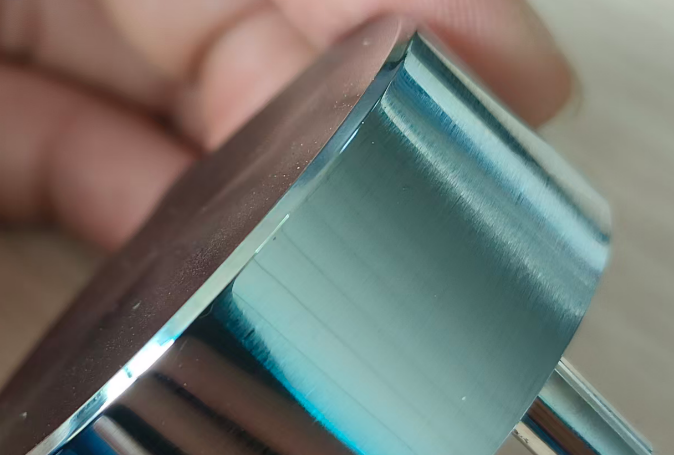
1. Low Finished Reflectance
Causes:
- Insufficient vacuum causing aluminum oxidation
- Evaporation rate too low, resulting in a porous coating
- Insufficient aluminum purity
Corrective Actions:
- Improve base vacuum level
- Increase evaporation rate
- Use higher-purity aluminum source material
2. Local Peeling or Delamination
Causes:
- Residual release agent or oil contamination after ultrasonic cleaning
- Insufficient ion-source cleaning before coating
- Excessive coating thickness causing stress overload
Corrective Actions:
- Strengthen ultrasonic cleaning procedures
- Perform ion-source pretreatment for 5–8 min
- Strictly control aluminum thickness to within 150 nm
3. White Spots, Pinholes, and Surface Defects
Causes:
- Dust contamination inside the chamber
- Material spitting from the crucible during aluminum evaporation
- Particle contamination on the substrate
Corrective Actions:
- Clean the coating chamber regularly
- Optimize electron beam parameters to prevent aluminum splashing
- Load substrates in a clean environment before coating
4. Whitening or Corrosion After Storage
Causes:
- Protective layer too thin or porous
- Moisture and salts in the air penetrate and corrode the aluminum layer
Corrective Actions:
- Increase protective layer thickness to above 70 nm
- For high-humidity applications, use Al₂O₃ as the protective layer