Metal Coatings | Aluminum / Silver / Gold / Chromium — Reference Optical Constants (n, k) and Reflectance Data
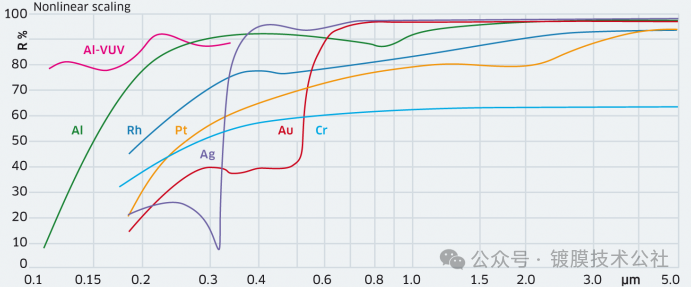
Although all are metallic coatings, their optical performance differs dramatically: silver achieves up to ~98% reflectance in the visible range, gold drops significantly in visible wavelengths but excels in the infrared, aluminum maintains broadband high reflectivity from UV to IR, while chromium exhibits nearly neutral attenuation behavior and is widely used for semi-transparent or ND coatings.
These differences are fundamentally determined by the optical constants n (refractive index) and k (extinction coefficient). Data is referenced across three key spectral regions: deep UV (0.22 μm), visible (0.5–0.7 μm), and near-to-mid infrared (2–10 μm), making it suitable for thin-film design software simulation and coating optimization.
1. Aluminum (Al) — Broadband High-Reflectivity Metal
| 波长区间 / Wavelength Range | 波长 / Wavelength | n / k | 垂直反射率 R / Reflectance | 应用场景 / Application | 备注 / Notes |
|---|---|---|---|---|---|
| 深紫外 / Deep UV | 0.22 μm | 0.14 / 2.35 | 91.8% | 紫外光学镜片、紫外光谱仪反光镜 / UV optics, spectrometer mirrors | 高能紫外应用 / High-energy UV use |
| 紫光 / Violet | 0.40 μm | 0.61 / 4.28 | 90.9% | 常规可见光起始波段 / Visible spectrum start | 基础光学应用 / Standard optics |
| 绿光 / Green | 0.51 μm | 0.82 / 5.44 | 91.6% | 人眼主峰、车灯反光杯 / Peak human vision, automotive reflectors | 高视觉敏感区 / High visual sensitivity |
| 红光 / Red | 0.65 μm | 1.05 / 6.52 | 92.2% | 车载成像镜头 / Automotive imaging systems | 成像优化波段 / Imaging optimized band |
| 近红外激光 / NIR Laser | 1.06 μm | 1.92 / 8.96 | 94.3% | YAG 激光反射镜 / YAG laser mirrors | 高功率激光应用 / High-power laser use |
| 中远红外 / Mid-Far IR | 10 μm | 25.46 / 67.39 | 98.0% | 红外测温、红外光学系统 / Thermal imaging systems | 热成像与测温 / Thermal detection |
Features: Broad-spectrum performance with no significant reflectance dips. A dense native Al₂O₃ passivation layer forms spontaneously at room temperature, providing excellent natural resistance to aging and environmental degradation. Reflectance shows only a minor drop to around ~86% near 0.85 μm. As a result, aluminum is widely used as the preferred substrate for automotive lighting reflectors, cold mirrors, and general-purpose reflective optics.
2. Silver (Ag) — Highest Visible Reflectivity, Not Suitable for UV
| Wavelength Band | Wavelength | n / k | Normal Incidence Reflectance (R) | Application | Notes |
|---|---|---|---|---|---|
| Deep UV | 0.22 μm | 1.35 / 0.52 | 28.7% | UV reflective optics | Severe performance degradation in UV |
| Violet | 0.40 μm | 0.07 / 1.03 | 93.9% | Visible spectrum edge optics | Transition region |
| Green | 0.51 μm | 0.06 / 3.41 | 98.3% | Precision mirrors, imaging systems | Peak reflectance region |
| Red | 0.65 μm | 0.07 / 4.89 | 98.8% | Projection mirrors, beam splitters | High-precision optical systems |
| NIR Laser | 1.06 μm | 0.32 / 7.25 | 99.0% | Laser optical systems | Excellent IR reflectivity |
| Mid–Far IR | 10 μm | 10.69 / 69.09 | 99.1% | Long-wave infrared systems | Stable high reflectivity in IR |
Features: In the visible range, the extinction coefficient (k) is much larger than the refractive index (n), resulting in extremely high reflectance. However, in the deep UV region below 320 nm, k drops sharply, causing reflectance to fall to only about 4–5%. The main drawback is its poor environmental stability—silver readily tarnishes in the presence of sulfur compounds in air, leading to surface darkening. Therefore, protective overcoats such as Al₂O₃ + SiO₂ multilayer barrier coatings are required.
3. Gold (Au) — Infrared-Oriented Metal Coating
| Wavelength Band | Wavelength | n / k | Normal Incidence Reflectance (R) | Application | Notes |
|---|---|---|---|---|---|
| Violet | 0.40 μm | 1.53 / 1.12 | 39.2% | Visible absorption dominant | Strong short-wavelength loss |
| Green | 0.51 μm | 0.80 / 1.84 | 50.4% | Gold color formation region | Visible absorption peak |
| Red | 0.65 μm | 0.31 / 3.15 | 88.5% | Infrared transition region | Reflectance increases rapidly |
| NIR Laser | 1.06 μm | 0.18 / 5.92 | 97.6% | Fiber lasers, IR optical components | High IR efficiency |
| Mid–Far IR | 10 μm | 7.41 / 53.49 | 99.0% | CO₂ laser cavity mirrors (10.6 μm) | Excellent long-wave IR reflector |
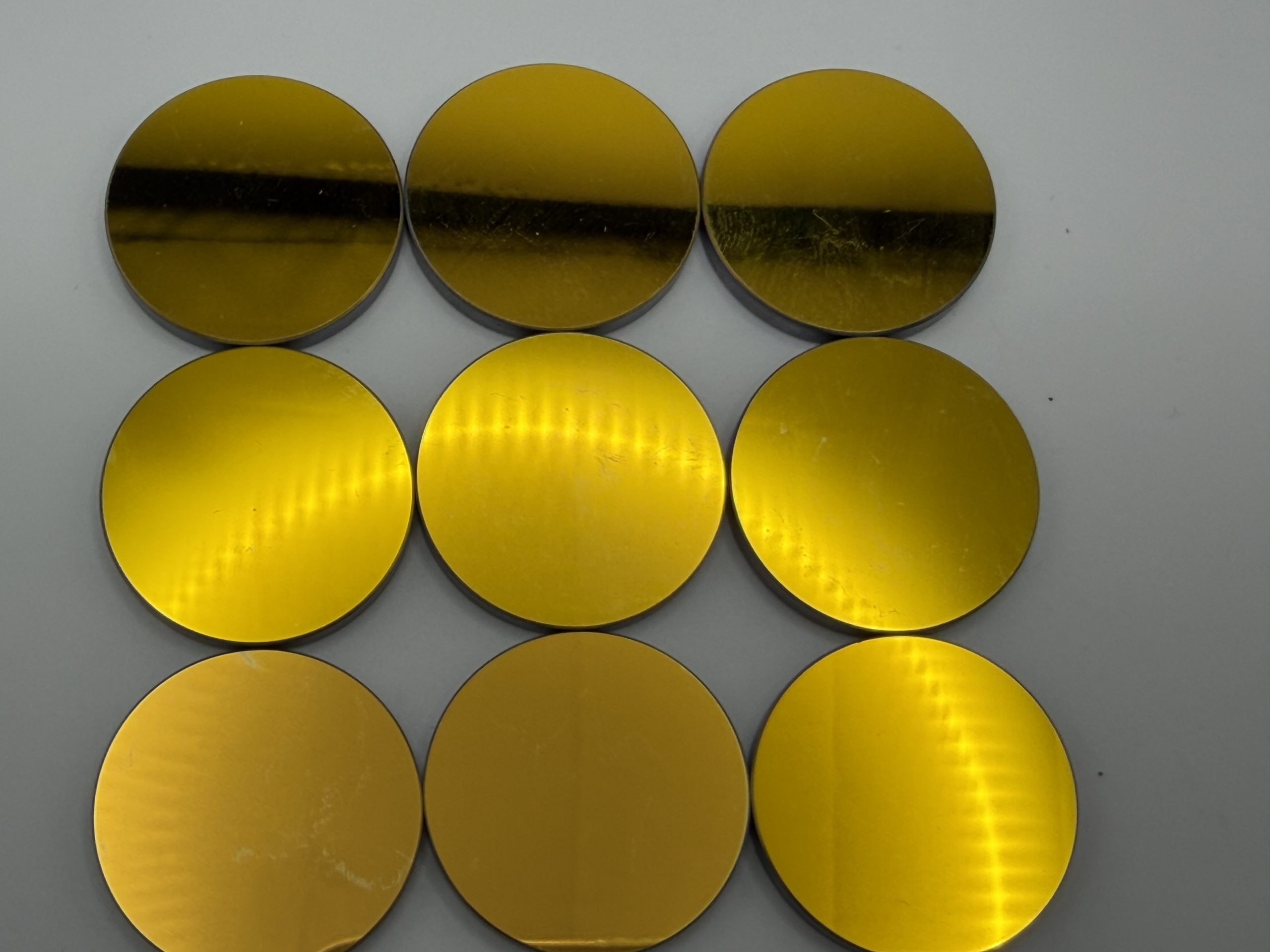
Features: In the visible range, the refractive index (n) and extinction coefficient (k) are relatively close, resulting in strong absorption and low reflectance. In the long-wave infrared region, k increases significantly, driving reflectance up to nearly 99%. Gold also offers excellent chemical stability with strong resistance to acids and alkalis, making it an ideal material for infrared reflective mirror applications.
4. Chromium (Cr) — Neutral Density Attenuation Coating
Visible-light reflectance is approximately 50–55% across the entire spectrum. The optical constants n and k are relatively balanced, leading to stable absorption behavior (R + T + A ≈ 100%, with absorption around ~40%) and no noticeable color bias.
Key characteristics include the best adhesion among all pure metals, allowing direct deposition on glass substrates without delamination. Chromium coatings are widely used for neutral density (ND) filters, optical scales, and non-selective beam splitters.
Understanding Spectral Behavior from n/k: Why the Four Metals Perform So Differently
- Aluminum (Al): A consistently high k value across the entire spectrum ensures stable reflectivity from ultraviolet to infrared, making it a versatile and cost-effective broadband reflective coating.
- Silver (Ag): The k value rises sharply in the visible range but drops significantly in the ultraviolet. This leads to excellent visible reflectivity, while UV performance is poor.
- Gold (Au): Exhibits relatively low k in the short-wavelength region and a strong increase in the long-wavelength infrared. As a result, it performs poorly in visible optics but excels in infrared applications.
- Chromium (Cr): Both n and k vary smoothly across the spectrum, producing a relatively neutral and wavelength-insensitive optical response. This makes it ideal for attenuation and beam-splitting applications.
Understanding Spectral Curves from n/k: Why the Applications of the Four Metals Differ So Much
- Aluminum (Al): The extinction coefficient (k) remains consistently high across the entire spectrum, enabling stable reflectance from UV to IR. This makes aluminum a universal, low-cost broadband reflective coating.
- Silver (Ag): In the visible range, k increases dramatically, resulting in extremely high reflectivity. However, in the UV region, k drops sharply, leading to poor UV performance and limited usability.
- Gold (Au): Exhibits relatively low k in the short-wavelength region and a strong increase toward longer wavelengths. As a result, it performs poorly in visible optics but is highly optimized for infrared applications.
- Chromium (Cr): Both n and k vary smoothly across the spectrum, producing a relatively neutral optical response. This makes it suitable for non-selective attenuation and beam-splitting applications.
Manufacturing Insights: How Deposition Parameters Affect Optical Constants
- For the same metal, variations in evaporation rate and vacuum level affect film density, which in turn alters n and k values.
- Lower evaporation rates tend to produce looser films, reducing k and leading to lower reflectance (e.g., silver deposited at low rates can lose over 1% reflectivity).
- Increasing substrate temperature promotes larger grain growth in the metal film, causing shifts in n/k values and a general drop in short-wavelength reflectance (for aluminum, substrate temperatures above 150°C can reduce UV reflectance by ~3%).