Metal Optical Coatings : Aluminum / Silver / Gold / Chromium — Reflectance and Optical Constants (n, k) Reference
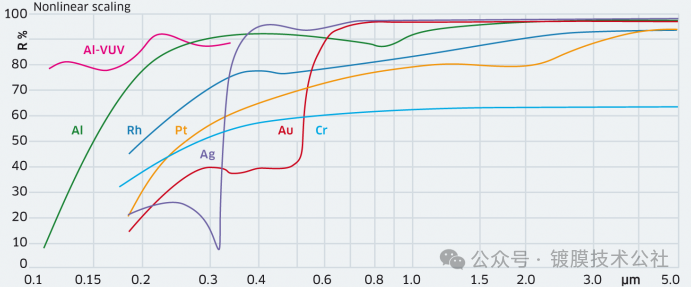
Metal coatings may look similar, but their optical behavior can be dramatically different. Why can silver achieve nearly 98% visible reflectance, while gold reflects much less in parts of the visible spectrum? Why is aluminum considered a broadband reflector, while chromium is widely used for neutral density attenuation?
The answer lies in two key optical constants:
- n — Refractive Index
- k — Extinction Coefficient (Absorption Coefficient)
These two values determine how a metal film interacts with light through reflection, absorption, and transmission.
The reference data below covers three key spectral regions commonly used in optical design:
- Ultraviolet (UV): 0.22 μm
- Visible: 0.5–0.7 μm
- Near to Mid Infrared (NIR–IR): 2–10 μm
These values can serve as practical references for optical coating design and simulation.
1. Aluminum (Al) — Broadband High Reflectance from UV to IR
Aluminum is one of the most widely used reflective coating materials because it maintains relatively high reflectance across a broad spectrum.
| Spectral Region | Wavelength | n | k | Reflectance (R) | Typical Applications |
|---|---|---|---|---|---|
| Deep UV | 0.22 μm | 0.14 | 2.35 | 91.8% | UV optics, spectrometer mirrors |
| Violet | 0.40 μm | 0.61 | 4.28 | 90.9% | General visible reflection |
| Green | 0.51 μm | 0.82 | 5.44 | 91.6% | Lighting reflectors |
| Red | 0.65 μm | 1.05 | 6.52 | 92.2% | Imaging optics |
| Near IR | 1.06 μm | 1.92 | 8.96 | 94.3% | YAG laser mirrors |
| Mid IR | 10 μm | 25.4 | 67.3 | 98.0% | Thermal imaging, IR systems |
Key Characteristics
- Stable reflectance across UV, visible, and infrared wavelengths.
- Naturally forms a dense Al₂O₃ passivation layer, improving oxidation resistance.
- Only a minor reflectance dip around 0.85 μm.
- Preferred for:
- Automotive lighting reflectors
- Cold mirrors
- General-purpose reflective optics
2. Silver (Ag) — Highest Reflectance in the Visible Spectrum
Silver delivers the highest visible-light reflectance among common coating metals, making it the preferred material for precision optical mirrors.
| Spectral Region | Wavelength | n | k | Reflectance (R) | Typical Applications |
|---|---|---|---|---|---|
| Deep UV | 0.22 μm | 1.35 | 0.52 | 28.7% | Not suitable for UV optics |
| Violet | 0.40 μm | 0.07 | 1.03 | 93.9% | Visible edge |
| Green | 0.51 μm | 0.06 | 3.41 | 98.3% | Peak visible reflectance |
| Red | 0.65 μm | 0.07 | 4.89 | 98.8% | Beam splitters, projection optics |
| Near IR | 1.06 μm | 0.32 | 7.25 | 99.0% | Infrared mirrors |
| Mid IR | 10 μm | 10.69 | 69.0 | 99.1% | Long-wave IR systems |
Key Characteristics
- Extremely high k values in visible wavelengths, driving reflectance close to the theoretical limit.
- UV performance drops sharply below 320 nm.
- Main challenge:
- Susceptible to sulfur contamination and tarnishing.
- Common solution:
- Apply protective layers such as Al₂O₃ + SiO₂.
Typical applications:
- Precision mirrors
- Projection optics
- Beam splitters
- High-end visible optical systems
3. Gold (Au) — The Preferred Choice for Infrared Reflection
Gold behaves very differently from silver and aluminum. Its strength is not visible reflection—but infrared performance.
| Spectral Region | Wavelength | n | k | Reflectance (R) | Typical Applications |
|---|---|---|---|---|---|
| Violet | 0.40 μm | 1.53 | 1.12 | 39.2% | Strong visible absorption |
| Green | 0.51 μm | 0.80 | 1.84 | 50.4% | Source of gold appearance |
| Red | 0.65 μm | 0.31 | 3.15 | 88.5% | Reflectance rises rapidly |
| Near IR | 1.06 μm | 0.18 | 5.92 | 97.6% | Fiber laser optics |
| Mid IR | 10 μm | 7.41 | 53.4 | 99.0% | CO₂ laser mirrors |
Key Characteristics
- Lower visible reflectance due to stronger absorption.
- Reflectance increases sharply in infrared wavelengths.
- Excellent chemical stability and corrosion resistance.
Typical applications:
- Infrared mirrors
- Laser systems
- Thermal imaging optics
- Harsh-environment optical components
4. Chromium (Cr) — Standard Material for Neutral Density and Beam Splitting
Chromium is valued less for maximum reflection and more for controlled optical attenuation.
Typical visible reflectance:
50–55%
Characteristics:
- Balanced n and k values across wavelengths.
- Stable absorption with minimal color shift.
- Excellent adhesion directly on glass substrates.
Typical applications:
- Neutral Density (ND) filters
- Beam splitters
- Optical gratings
- Measurement scales and reticles
Understanding Optical Performance Through n and k
The optical behavior of metal coatings can largely be explained by how n and k vary with wavelength:
Aluminum
High k across the spectrum → Stable broadband reflection → General-purpose reflective coating
Silver
Very high k in visible → Maximum visible reflectance → Poor UV performance
Gold
Low short-wave k, high long-wave k → Optimized for infrared applications
Chromium
Balanced n and k → Neutral reflection and controlled attenuation
Production Considerations: How Process Parameters Affect Optical Constants
Optical constants are not fixed values in production. Deposition conditions can shift actual film performance.
1. Deposition Rate
Slower evaporation may create a less dense film structure.
Result:
- Lower k
- Reduced reflectance
(For silver, reflectance loss may exceed 1%)
2. Vacuum Quality
Insufficient vacuum introduces contamination and changes optical properties.
3. Substrate Temperature
Higher temperature promotes grain growth and changes film density.
Example:
- Aluminum deposited above 150°C may show a ~3% reduction in UV reflectance
Understanding n and k is the foundation of optical coating design. Selecting the correct metal is not simply choosing the highest reflectance—it is matching spectral performance, durability, manufacturing process, and application requirements.